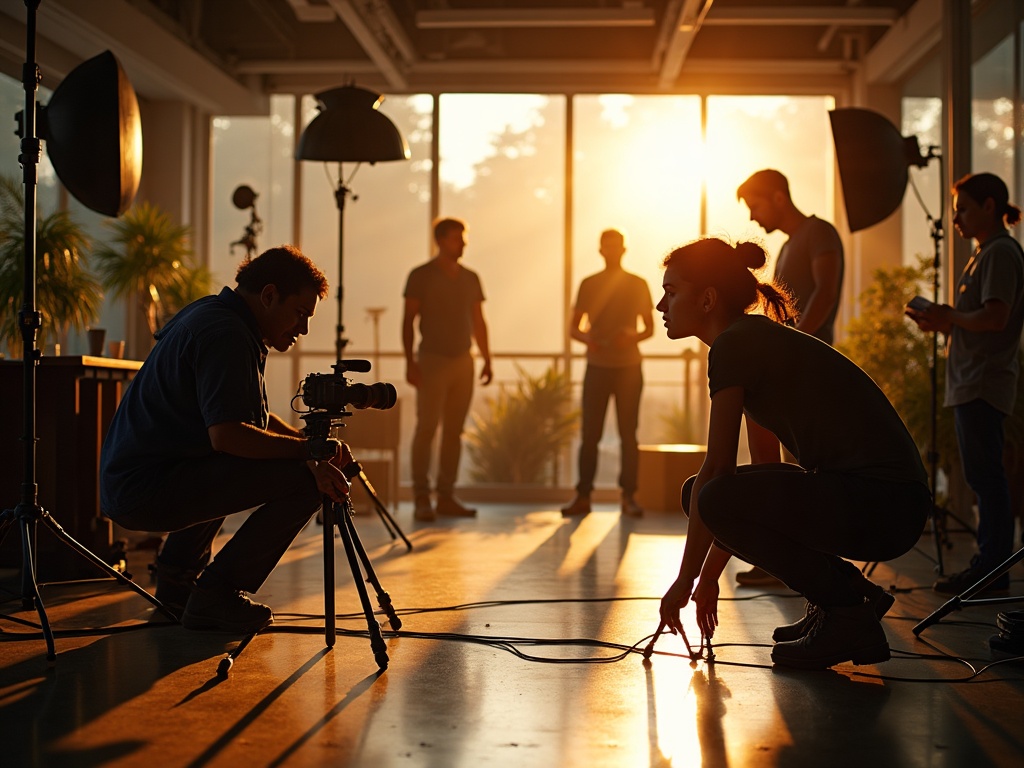
Inside the Production Day: What Actually Happens When a Professional Crew Shows Up
The brief said "simple product reveal on white background." The client's email chain was optimistic. Your producer sent a call sheet at 6 a.m. And now it's 7:47 a.m., the sun is already hot, and three things have already changed.
If you've never sat on a professional production set, or if you're the person who hired the crew without knowing what eight hours actually looks like, this post walks through what a real shoot day looks like — from the moment the truck pulls up to the moment the last battery gets packed away.
The Pre-Shoot Window (6:30 a.m. to 8:30 a.m.)
Your crew has been up longer than you think.
The production designer and gaffer have already scouted the location the day before. They know where the sun comes in, where shadows fall at 9 a.m., and which walls are usable. The first truck arrives 90 minutes before the advertised crew call. It's the grip and electric team unloading stands, reflectors, lights, cable, tape, and probably three backup solutions for whatever they're about to light.
What's actually happening:
- The location is being checked against the pre-production photos. Windows are measured. Ceiling heights are confirmed. Power outlets are tested (they're often not where you think they are).
- Lighting is being rigged. Even a "simple white background" needs thought: you have to light the product, light the background separately so it reads as pure white in camera, and light your talent without washing them out. This takes longer than it sounds.
- Sound is running a cable check. A wireless mic needs line-of-sight to the receiver. If your talent moves twelve feet left, the signal might drop. The sound recordist is already thinking two steps ahead.
- The AD (assistant director, or producer if it's a small crew) is confirming talent arrival time, catering arrival time, and whether the client is actually coming or just calling in later.
By 8:15 a.m., the set feels chaotic but organized. There's a lot of standing around. There's a lot of invisible problem-solving.
The Crew Call (8:30 a.m. to 9:15 a.m.)
Everyone arrives. The director briefs the full crew — takes maybe ten minutes. The DP (director of photography) walks through camera positions and lens choices. The gaffer confirms lighting levels. The focus puller runs a test on the camera to nail focus distances. The boom op gets the wireless mic on talent and does a quick audio check.
Here's what people on Zoom never see: the amount of conversation that happens before rolling. The DP and gaffer are constantly talking about aperture, shutter speed, and whether the light ratio feels right. The sound recordist is asking about background noise (is that AC unit running? That fridge humming? Will it be a problem in post?). The focus puller is checking depth of field, because pulling focus on a fast lens in close-up is genuinely difficult work.
This is also when the first real adjustment happens. The client said "bright and energetic," but the actual space is smaller than the brief suggested, and the white background is reading gray under these lights. The DP talks to the director. They make a call. Maybe they adjust the lights. Maybe they accept the gray and plan to fix it in post-production color grading.
The First Take (9:15 a.m. to 10:30 a.m.)
You'd think this is when production starts. It's not really. The first take is almost always a test.
Everyone does a full rehearsal. Talent walks through their marks. The camera finds focus. The boom stays out of frame. Then you roll — not for the client, but to see if everything works together. Often something doesn't. The talent's eye line is slightly off. The light is catching the product in a way that creates a flare. The audio picks up a floor creak.
Notes get called. Everyone adjusts. You roll again.
Between takes, the crew is not idle. The focus puller resets. The grip checks whether a reflector needs angling. The gaffer watches light falloff. Sound is listening for external noise — if a car passes outside, they might ask to pause and wait for quiet.
By take four or five, you usually have something. The director watches it back on the monitor. The client watches it back if they're on set (and if they're remote, someone is taking notes from the call). Then the question: "Do we get another, or move on?"
This depends entirely on the brief, the client's confidence, and how far behind schedule you are.
The Middle Hours (10:30 a.m. to 1:00 p.m.)
This is where most production happens, and it's where time actually moves.
You're cycling through setups. Camera moves, or lighting changes, or you're shooting the same scene from multiple angles for editing flexibility. The AD is watching the clock — you have six setups planned, and you're on setup three with four hours left.
Here's what's really happening:
- Between setups, the gaffer and grip are reconfiguring lights and stands. This takes longer when you change the camera angle significantly.
- The focus puller is taking fresh measurements to the new camera position.
- Talent is waiting. A lot of waiting. There's a monitor for them to check performance, but mostly they're sitting, staying in character, staying hydrated.
- The director is often looking at playback, consulting with the DP about whether the shot works.
- Someone is checking continuity — is the talent's hand in the same position as the last take? Is the product exactly where it was?
The producer or AD is the nervous system of this operation. They're managing pacing, flagging if you're falling behind, and deciding whether to cut a setup if time is running short.
Lunch (1:00 p.m. to 2:00 p.m.)
Catering arrives (if budgeted). Everyone eats. The crew resets slightly — some crew members might shift out if the next setups don't need them. Producers and the director often use this time to regroup: Are we ahead or behind? Do we have everything we need? What gets cut if we run over?
The Afternoon Push (2:00 p.m. to 5:00 p.m.)
Energy usually drops slightly after lunch, but the pacing picks up because you're running against clock-out time. The crew knows their rates tick up if you go into overtime. The director is making faster decisions. You're moving through setups quicker.
This is also when improvisation sometimes happens. A setup that wasn't in the shot list works really well, and suddenly you're rolling on something that's saving you in post-production. Or the opposite: the shot you spent an hour setting up doesn't feel right, and you move on.
The light changes as the afternoon progresses. If you're shooting near windows, the angle of sunlight is shifting. The gaffer has been watching this the whole time and has already begun compensating.
The Wrap (5:00 p.m. to 6:00 p.m.)
The director calls it. You have everything you need, or you've run out of time — both happen regularly. The producer does a final inventory: "Do we have alternate takes of the hero shot? Do we have coverage of the transition? Is there anything we're obviously short on?"
Then it's a controlled chaos of breaking down. Stands get collapsed. Lights get powered down and packed. Cables get coiled. The sound recordist backs up the audio files. The camera op backs up the video files. Nothing leaves until the media is accounted for.
The crew clocks out. The producer does a final walk-through of the location to make sure nothing is left behind. By 6 p.m., it looks like nothing was ever there.
What This Teaches You
A professional production day isn't about capturing one perfect shot. It's about managing dozens of variables simultaneously — light, time, talent performance, equipment, contingency, and client expectations — while staying technically precise.
When a crew feels slow, they're often solving invisible problems. When a crew feels fast, it's because they've thought through those problems before you arrived.
If you're hiring a production company or planning a shoot, understanding this rhythm helps you brief better, set realistic expectations, and appreciate why certain crews are worth booking again. They make the complex look invisible.
At GloryForest, we think about this structure on every shoot — from the first briefing call to the moment media walks out the door. It's the difference between footage and film.