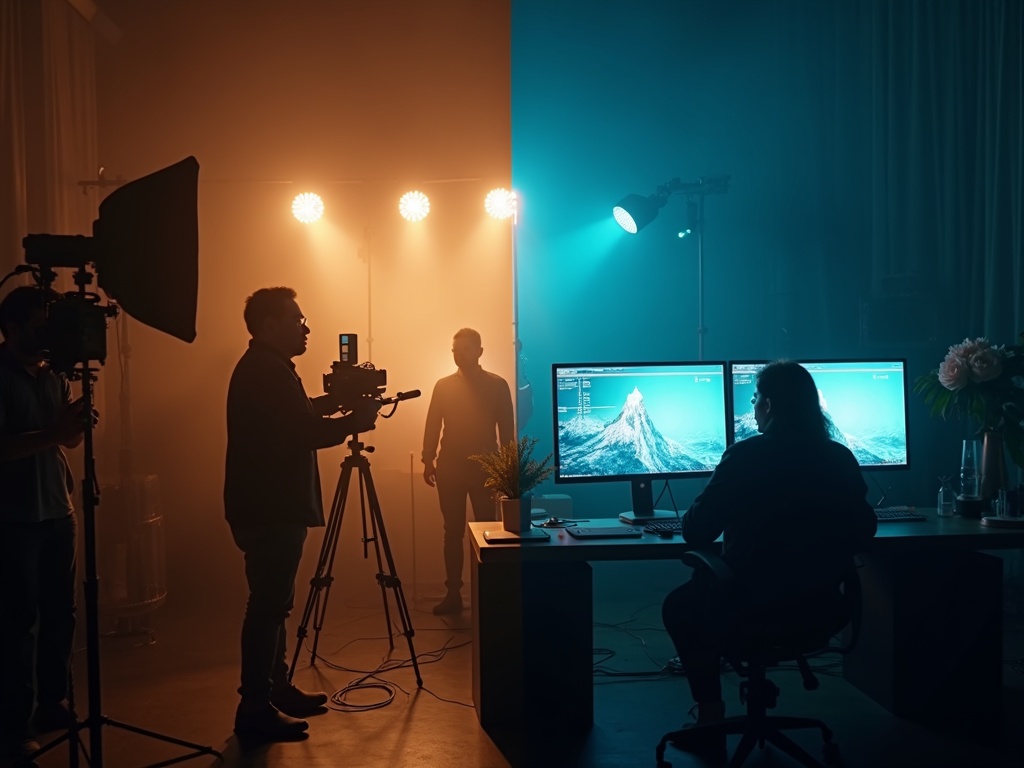
Same Brief, Different World: How AI Video Production Actually Changes the Game
Picture this: a brand manager gets a brief on a Monday. The campaign needs a thirty-second hero video, three cut-downs, and a product demo clip -- all live by Friday for a regional launch.
In 2019, that brief would have made any producer wince. Today, depending on how you answer one foundational question, it is either still impossible or entirely routine. That question is: are you making this the traditional way, or are you using AI-assisted production?
The answer changes almost everything -- not just the timeline, but the workflow logic, the team structure, the revision process, and which creative ideas are even worth pitching.
Here is a clear-eyed breakdown of what is actually different between the two approaches, and why it matters for brand marketers and creative directors making production decisions right now.
The Workflow Is Fundamentally Restructured
Traditional production follows a sequential logic: pre-production locks before a shoot happens, the shoot generates the raw material, and post-production transforms that material into the final asset. Each phase is largely dependent on the one before it. Changing a costume means going back to wardrobe. Changing a location means rescheduling. Changing a line of dialogue in post means either a re-shoot or an awkward cut.
AI-assisted production does not have the same hard dependencies. Visual elements can be generated, iterated, or replaced at almost any stage. A background environment, a product configuration, a lighting setup -- these exist as adjustable parameters rather than fixed production decisions. The workflow becomes more parallel and less linear.
This is a real structural difference, not a minor efficiency gain. It means the revision cycle changes completely. In traditional production, revisions are expensive because they often require re-shooting physical elements. In AI production, many revisions are simply regenerative -- you update an input and render again.
Speed: Where the Gap Is Real and Where It Isn't
AI production is genuinely faster at certain things: generating visual options, exploring concept variations, producing multiple format cuts from a single core asset, and turning a storyboard into a rough visual proof of concept.
It is not automatically faster at everything. Crafting a strong concept still takes creative thinking. Prompt engineering to get a specific aesthetic right takes skill and iteration. Integrating AI-generated elements with live footage, voiceover, or brand-specific assets requires careful coordination.
The honest picture: AI production compresses the middle phases of production significantly. Pre-production ideation can move faster because you can visualise concepts before committing to them. Post-production asset generation is faster. But the creative judgment required at both ends of that pipeline still demands experienced people.
Cost: It Is Not Simply Cheaper
The common assumption is that AI production costs less. That is sometimes true, but it depends heavily on what you are making and what quality benchmark you are holding.
For content that previously required a full crew, a location booking, talent fees, and a post-production house, AI production can reduce the total cost substantially. A Singaporean F&B brand that previously needed a full production day to shoot a seasonal menu campaign can now produce high-quality visual content with a much smaller operational footprint.
But for premium commercial work -- broadcast TVCs, flagship brand films, content where authentic human presence is non-negotiable -- traditional production still has a role, and trying to replace it wholesale with AI often produces work that reads as hollow or off-brand.
The more useful framing is this: AI production changes the cost-to-output ratio for a specific tier of content. It does not flatten all production costs across all content types.
Creative Control: More Variables, Not More Freedom
This is where many creative directors find the reality more nuanced than the marketing around AI tools suggests.
Traditional production gives you control through physical precision. You direct a performance. You control a frame. You make a deliberate compositional choice. The craft is in the directing and the execution.
AI production gives you control through a different mechanism: you are shaping outputs through inputs, constraints, and iteration. That requires a different kind of creative muscle. The director becomes part editor, part prompt architect, part systems thinker. Some creative directors find this liberating. Others find it disorienting.
The key insight: AI production does not reduce the need for creative vision. It changes the form in which that vision is expressed. A weak brief produces weak AI output just as reliably as it produces weak traditional work.
Where Each Approach Actually Wins
Traditional production is still stronger for:
- Campaigns where genuine human performance is the creative centrepiece
- Brand films that require documentary-style authenticity
- Work where a specific location, texture, or material quality cannot be approximated digitally
- High-stakes broadcast spots where production value is itself part of the brand signal
AI production is genuinely stronger for:
- High-volume content across multiple formats and markets
- Rapid concept visualisation and pre-production prototyping
- Product-focused visuals where physical shoots are logistically complex
- Regional campaign adaptation where the same core asset needs to flex across languages, markets, and platforms
The Practical Position for Brands Right Now
The sharpest brand teams are not choosing one approach over the other. They are learning where the boundary sits for their specific content mix, and deploying accordingly. A healthcare brand in Singapore might use traditional production for its brand story film and AI production for its ongoing content series. A retail group might prototype campaign visuals with AI before committing a production budget to a traditional shoot.
Studios like Glory Forest are building exactly this kind of hybrid capability -- the ability to advise clients on which approach serves which brief, rather than defaulting to either end of the spectrum.
The bottom line is straightforward: AI video production and traditional production are not competing for the same jobs. They are increasingly two distinct production modes with different strengths, different workflows, and different creative demands. The brands that understand that distinction are going to make better decisions with their production budgets and get sharper work out of both.